
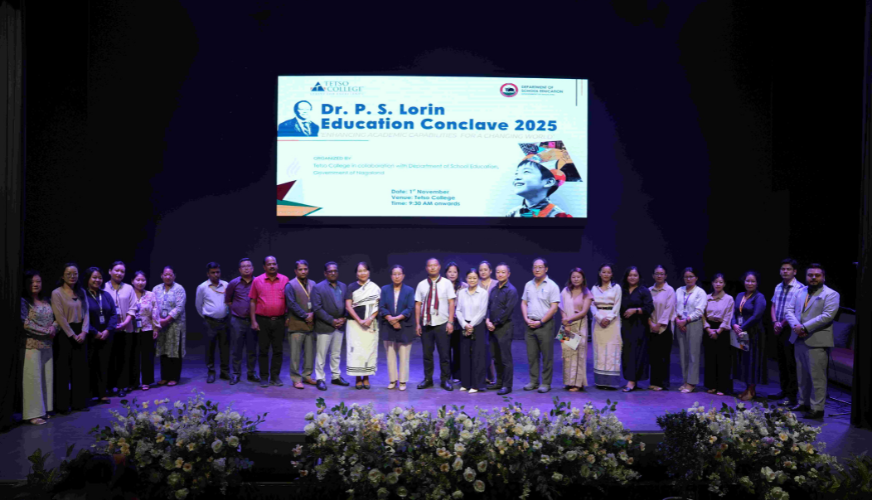
Tetso College, in collaboration with the Department of School Education, Government of Nagaland, hosted a one-day state-level event titled Dr. P. S. Lorin Education Conclave 2025: 'Enhancing Academic Capabilities for a Changing World', on November 1st, 2025, as part of the annual Dr. P. S. Lorin Lecture Series, with Dr. Kekhrielhoulie Yhome, Advisor, School Education & State Council of Educational Research and Training (SCERT), Government of Nagaland as the special guest during the inaugural programme.
The conclave aimed to bring together school principals, senior teachers, students, and education stakeholders from across Nagaland to engage in meaningful dialogue, build capacities, and spark academic innovation while serving as a platform to exchange knowledge, discuss pressing education issues, and explore strategies to navigate the rapidly evolving educational landscape shaped by the National Education Policy (NEP) 2020.
Shri Kvulo Lorin, Chairman, Tetso College delivered the welcome note, mentioning the importance of collaboration among educators in the state to enhance the quality of education in the state. Mr. Lorin also announced that Tetso College is offering full scholarships to two government school class 12 graduates to pursue higher studies in the college, along with a monthly stipend. During the inaugural, students of Quest Fulfill School, Dimapur displayed an enthralling cultural performance - Hao, a traditional dance of Sangtam Naga tribe.
Delivering the keynote address, Nagaland School Education Advisor Dr. Kekhrielhoulie Yhome outlined a vision for a reformed education system rooted in Naga identity, while also highlighting persistent challenges of perception and curriculum. Dr. Yhome began by paying tribute to the late Dr. PS Lorin, acknowledging his "significant contribution" to Naga society through education.
He reported that the school education sector in Nagaland is currently undergoing a major transformation, backed by a substantial investment of approximately ₹9,400 crores. Despite this financial commitment and the state's ranking as the third most literate in India, Dr. Yhome pointed to a critical issue: a lack of public esteem for government schools.
"A perception problem exists towards our government school students, teachers, and graduates. This needs to change," he stated, identifying this shift in attitude as crucial for progress. The Advisor argued that the core of the issue lies in the system's design. "Since our system design is wrong, we need to rebuild Naga pride with a sense of responsibility in our education sector," he asserted. A key part of this rebuilding, according to Dr. Yhome, is embracing Nagaland's unique culture. He recalled that his own school education was dominated by topics pertaining to other states, leaving local identity sidelined. He emphasised the importance of the "communitarian spirit" and the "mosaic of culture" that defines the Naga people. Calling the Northeast a region "endowed with creativity," Dr. Yhome concluded that the education system must work to enhance and promote this innate talent, weaving it into the very fabric of learning in Nagaland.
The first panel discussion titled "Exploring the Shift in Academic Interests of Naga Students: Opportunities & Challenges" analyzed the prevailing academic trends in the state. Moderated by Dr. Wapangsenla Imchen, Associate Professor -
Management, Tetso College, the panel featured insights from Shri. Nellayappan B (OSD to Chief Minister, Nagaland, & Deputy Director, Department of School Education, Government of Nagaland, Dr. Sedevi Angami (Director, Christian Institute of Health Sciences & Research, Dimapur), and Dr. Mary N. Odyuo (Associate Professor, Agricultural Extension Education, School of Agricultural Sciences,Nagaland University), with Dr. Hewasa L Khing (Principal, Tetso College) serving as the discussant. The discussion centered on the observed preference among Naga students for traditional humanities courses over emerging, vocationally-oriented fields like Management, Computer Sciences, and Mass Communication among others.
A talk on "Purposeful Pedagogical Innovation" was also held, focusing on the theme "Innovation Begins with Clarity: Instructional Practice Grounded in Learning Outcomes." The session, moderated by Smti. Renthunglo Shitiri (HoD - English & PGT, Delhi Public School, Dimapur, and Writer) featured resource person Ms. Initoli Vinito Chishi (Education Consultant, Curriculum, Pedagogy and Assessment Specialist, Nagaland Education Project - The Lighthouse (NECTAR), Department of School Education). The core message emphasized that true innovation in teaching is not merely about using new tools, but must start with a clear definition of desired learning outcomes. The discussion centered on aligning instructional methods and classroom practices directly with these specific goals to ensure effective and meaningful learning for students.
The second panel discussion titled "Innovating Under Pressure: Lessons from Government and Private School Leaders" brought together leaders from both educational sectors. Moderated by Shri. Asalie Peseyie (Founder. Infinity Inc. Nagaland), the panel featured Smti. Nini Sekhose (Ex-Officio Advisor of ANPSA Central), Smti. P. Aienla Longkumer (Principal, Government Higher Secondary School, Singrijan), and Smti. Sashi Imchen (Academic Director, Maple Tree School,
Dimapur). Drawing on real-world experiences, the discussion focused on how school leaders employ creativity, resilience, and adaptive leadership to overcome challenges. The session highlighted practical strategies for collaborative problem-solving and sustaining educational quality amid various constraints. The central aim was to explore how adversity can be transformed into opportunity, fostering a culture of shared learning and innovation across Nagaland's schools.
Meanwhile, parallel workshops on personality development and career choices for school students were also held simultaneously. Loyola Higher Secondary School, Jakhama emerged as the winning team of the group discussion titled 'Ready for a Career: How Can Schools Help?'