
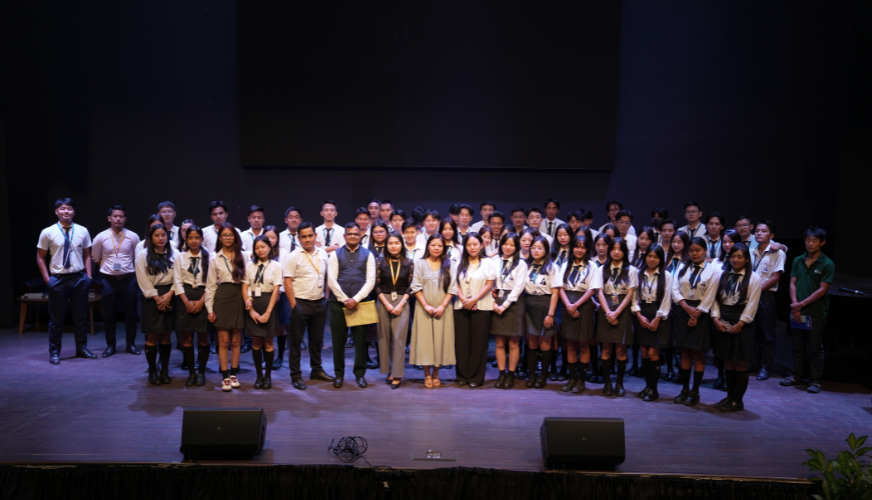
The Department of Mass Communication, Tetso College, observed the International Day of Democracy with a panel discussion on the theme “The Post-Truth Dilemma: Unpacking Fake News, Misinformation and Democratic Fragility” at Lorin Hall on September 15, 2025. The discussion featured Samuel Beech, journalist with Nagaland Post; Akangjungla Longchar, Director of News & Administration, Morung Express; and Dr. Daniel Michal Khan, Assistant Professor, Department of Political Science. The session was moderated by Dr. Vanlal Chhanchhuahi, Assistant Professor, Department of Mass Communication, and chaired by Tsütipang Jamir, Assistant Professor, Department of Mass Communication.
The programme commenced with a welcome note by Dr. Rosy Tep, Vice Principal, Tetso College.
Opening the discussion, journalist Samuel Beech of Nagaland Post reflected on how the landscape of journalism has drastically changed over the years. “When I first started my career as a journalist, it was about feeding my intellect and finding meaning in the profession. Today, the challenge is no longer just about reporting facts but about fighting fake news,” he remarked.
Describing misinformation as a “full-blown challenge that is reshaping journalism,” Beech observed that the rise of unverified online content has blurred the line between professional journalism and casual social media commentary. He urged students to think critically before sharing information online and also underlined that journalism should make those in power accountable and that investigative reporting must be revived despite the risks it carries.
Panelist Akangjungla Longchar, Director of News & Administration, Morung Express, unpacked the idea of post-truth as a period “where facts no longer matter.” She explained that misinformation thrives because it appeals to emotions more than reason, which deepens divisions and erodes society’s shared reality.
“News is a form of knowledge that shapes society. Without ethical responsibility, journalism risks becoming propaganda,” she cautioned, stressing that public debate should not collapse into emotional noise measured merely in likes and shares. She called for education to play a central role in building media literacy, arguing that schools and colleges must equip young people with critical thinking skills to discern fact from opinion. “Education must create informed, ethical citizens capable of questioning the information they consume. Without this, democracy itself is at risk,” she said.
Dr. Daniel Michal Khan, assistant professor, department of political science observed that a democracy cannot thrive without informed citizens. He encouraged students to go beyond passive consumption of social media and actively engage with news, research, and public dialogue. “Democracy needs a vigilant and aware citizenry; otherwise, it becomes vulnerable to manipulation,” he noted.
The panel concluded with an interactive Q&A session where students shared concerns and reflections about navigating misinformation in the digital age. Toka V, Assistant Professor, Department of Mass Communication delivered the vote of thanks. Students from the Departments of Mass Communication, Political Science and English attended the discussion.